
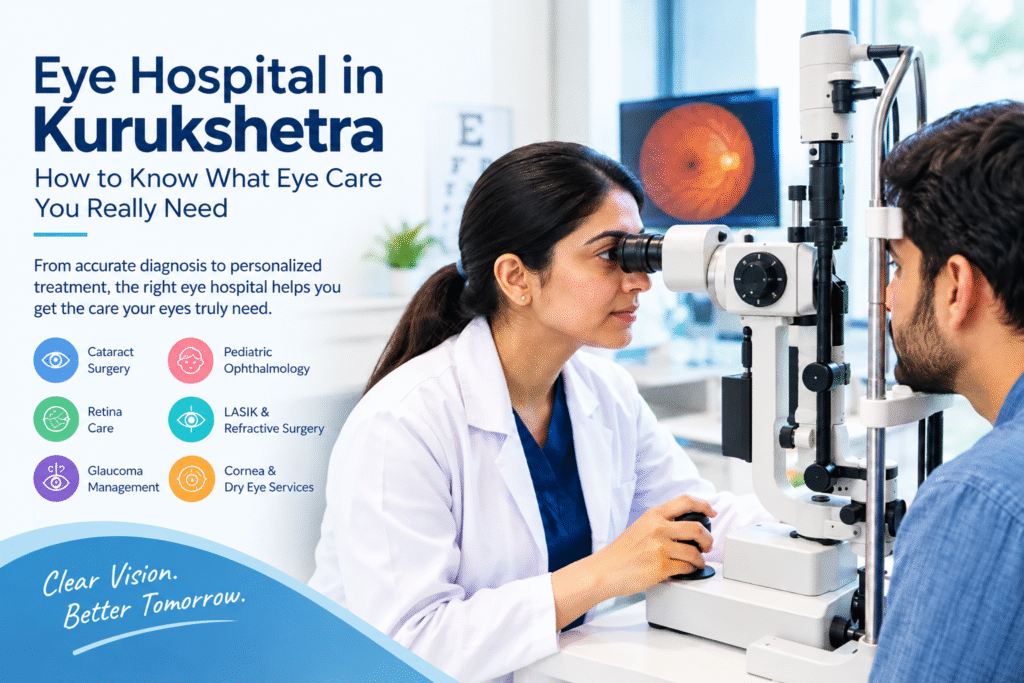
Choosing the eye hospital in Kurukshetra is not only about finding a place that offers eye surgery. The more important question is whether the hospital can identify the actual cause of your vision problem, perform the right evaluation and guide you toward treatment that suits your individual eye health.
Blurred vision, difficulty reading, frequent changes in glasses, eye redness, flashes or floaters, difficulty seeing at night and headaches can have very different causes. A person with diabetes may require retinal evaluation, while someone with increasing eye pressure may need glaucoma assessment. A child struggling at school may need a pediatric eye examination rather than simply a stronger pair of glasses. Someone considering LASIK needs a detailed assessment of the cornea and refractive stability before deciding whether laser vision correction is appropriate.
This is why comprehensive eye care matters.
At Saini Eye Care Centre, Kurukshetra, patients can access several areas of ophthalmic care, including cataract surgery, retina care, glaucoma management, pediatric ophthalmology, LASIK and refractive surgery, and cornea and dry-eye services. The centre states that its approach combines diagnostic and surgical care with personalized treatment planning.
The right eye hospital should therefore help you answer three basic questions:
- What is causing my vision problem?
- Do I need treatment, monitoring or simply a change in prescription?
- If treatment is required, which option is appropriate for my eyes and lifestyle?
Why Choosing the Eye Hospital in Kurukshetra Starts With the Right Diagnosis
Many eye conditions do not produce the same symptoms in every patient. Some may develop gradually, while others can affect vision without obvious early warning signs.
For example, diabetic retinopathy can initially have few or no noticeable symptoms. Regular comprehensive eye examinations are therefore important for people with diabetes. The National Eye Institute recommends that people with diabetes have a comprehensive dilated eye examination at least once a year, although the exact frequency can vary according to individual circumstances and the advice of the treating doctor.
Glaucoma is another condition where early assessment matters because damage to the optic nerve can occur before a patient notices major changes in vision.
Cataract is different. It commonly causes cloudy or blurred vision, glare, difficulty seeing at night and other changes that gradually interfere with everyday activities. Cataract surgery may be considered when vision loss begins to affect activities such as reading, driving or watching television.
The lesson is simple: the same complaint does not always mean the same diagnosis.
A good eye-care consultation should therefore begin with an appropriate examination rather than immediately assuming that a particular treatment is required.
What Should a Comprehensive Eye Evaluation Include?
The exact tests required depend on your age, symptoms, medical history and suspected condition. An eye specialist may assess several aspects of your vision and eye health.
1. Visual Acuity
A visual acuity test measures how clearly you can see at different distances.
It can identify refractive problems such as myopia, hyperopia and other vision-related issues. However, normal visual acuity does not necessarily mean that the eyes are completely healthy.
2. Eye Pressure Assessment
Eye pressure measurement, commonly called tonometry, can be part of an examination for glaucoma.
Raised eye pressure is an important risk factor for glaucoma, but glaucoma assessment involves more than simply checking one number. The ophthalmologist may consider the optic nerve, visual field and other findings before determining whether further investigation or treatment is necessary.
3. Examination of the Retina
The retina is the light-sensitive tissue at the back of the eye. Problems affecting the retina can occur because of diabetes, age-related conditions, vascular problems and other causes.
A retinal examination may be particularly important if you have diabetes, sudden changes in vision, flashes, new floaters or other symptoms that could indicate a retinal problem.
4. Corneal Evaluation
The cornea is the transparent front surface of the eye. Its shape and thickness are particularly important when evaluating patients for refractive procedures such as LASIK.
A detailed corneal assessment can help an ophthalmologist determine whether laser vision correction is appropriate and whether another approach should be considered.
5. Dilated Eye Examination
Dilation allows an eye specialist to examine structures inside the eye more thoroughly. The National Eye Institute notes that dilation can help doctors evaluate conditions including diabetic retinopathy, glaucoma and age-related macular degeneration.
After dilation, temporary blurred vision and light sensitivity can occur, so patients may need to plan accordingly.
When Should You Consider a Retina Specialist?
Retinal conditions deserve particular attention because some can threaten central or overall vision.
Saini Eye Care Centre’s published retina services include care for diabetic retinopathy, age-related macular degeneration, retinal detachment, macular edema and retinal vascular conditions. The centre also lists diagnostic services such as OCT, fundus photography, fluorescein angiography and ocular ultrasound.
If you have diabetes, regular retinal assessment can be especially important. Diabetic retinopathy may progress without obvious symptoms during its early stages. Once symptoms become noticeable, the disease may already require treatment.
Some symptoms should receive prompt medical attention.
These include:
- A sudden increase in floaters
- Flashes of light
- A sudden shadow or curtain-like area in your vision
- Sudden or unexplained vision loss
- Significant distortion of vision
A sudden curtain or shadow across the field of vision, particularly when associated with flashes or numerous new floaters, can be a warning sign of retinal detachment and requires urgent assessment.
Do not wait for a routine appointment if you experience sudden or severe changes in vision.
Diabetes and Eye Health: Why Routine Screening Matters
Diabetes can affect several parts of the eye. Diabetic retinopathy is one of the most important diabetic eye complications, but people with diabetes are also at increased risk of cataract and glaucoma.
The absence of symptoms should not be considered proof that the retina is healthy.
Regular eye examinations allow an ophthalmologist to identify changes before they become more advanced. Managing blood glucose and following the treatment plan recommended by your medical team also plays an important role in reducing the risk of diabetes-related complications.
For people with diabetes searching for the eye hospital in Kurukshetra, it is therefore useful to look beyond general vision testing and consider whether the centre provides appropriate retinal evaluation and ongoing monitoring.
Saini Eye Care Centre lists diabetic retinopathy management within its retina services.
For more information, visit the centre’s retina care page:
https://sainieyecarecentre.com/retina-care-services-in-kurukshetra/
Cataract Care Is About More Than Blurry Vision
Cataracts occur when the natural lens of the eye becomes cloudy. Vision may gradually become hazy, colours may appear less vivid, bright lights may cause glare, and night-time activities can become more difficult.
Not every cataract requires immediate surgery.
The decision depends on how much the cataract is affecting vision and daily activities, along with the findings of the eye examination and the patient’s individual circumstances.
The National Eye Institute explains that cataract surgery is the only way to remove a cataract and is generally considered when vision loss interferes with everyday activities.
Saini Eye Care Centre’s cataract service describes evaluation of the eye, lens measurements and discussion of intraocular lens options as part of the process. The centre also publishes information about phacoemulsification and femto-assisted laser cataract surgery.
Patients can learn more here:
What Should You Ask Before Cataract Surgery?
A useful cataract consultation should give you an opportunity to discuss:
- How much the cataract is affecting your vision
- Whether surgery is currently necessary
- Which type of intraocular lens may be appropriate
- What visual outcome can reasonably be expected
- What preparation is required
- What recovery and follow-up involve
- Whether another eye condition could affect vision after surgery
The choice of lens should be based on clinical findings and the patient’s visual needs rather than simply choosing the most expensive option.
Glaucoma: Why Waiting for Symptoms Can Be Risky
Glaucoma is a group of eye diseases that can damage the optic nerve and cause permanent vision loss.
One of the challenges with glaucoma is that significant damage can develop before a person becomes aware of a problem. This makes appropriate screening and follow-up particularly important for people who have risk factors or have already been diagnosed with glaucoma.
Saini Eye Care Centre provides glaucoma management and states that its approach includes early detection as well as medical and surgical treatment options.
More information is available at:
https://sainieyecarecentre.com/glaucoma-management/
The National Eye Institute notes that treatment for glaucoma can include medicines, laser treatment or surgery depending on the type and severity of the disease.
The goal is not simply to improve vision temporarily. Glaucoma treatment is primarily aimed at controlling the disease and protecting remaining vision.
Is LASIK Suitable for Everyone?
LASIK can reduce dependence on glasses or contact lenses for suitable patients, but it is not appropriate for everyone.
The National Eye Institute explains that LASIK is commonly used to correct refractive errors such as nearsightedness, farsightedness and astigmatism. However, stable vision and an appropriate eye examination are important when assessing candidacy.
Certain eye conditions can increase the risk of complications or make LASIK unsuitable.
This is why a consultation should come before deciding on surgery.
Saini Eye Care Centre’s LASIK service describes pre-operative evaluation including corneal mapping, corneal thickness measurement and assessment of vision stability.
You can read the centre’s published LASIK information here:
Questions to Discuss During a LASIK Consultation
If you are considering laser vision correction, ask your ophthalmologist:
- Is my prescription stable?
- Is my corneal thickness appropriate?
- Is my corneal shape suitable for LASIK?
- Do I have dry eye or another condition that needs treatment first?
- What are the possible side effects?
- What visual result is realistic for me?
- Will I still need glasses for some activities?
- What follow-up appointments will be required?
A responsible LASIK consultation should involve both benefits and potential risks.
Glaucoma: Why Waiting for Symptoms Can Be Risky
Glaucoma is a group of eye diseases that can damage the optic nerve and cause permanent vision loss.
One of the challenges with glaucoma is that significant damage can develop before a person becomes aware of a problem. This makes appropriate screening and follow-up particularly important for people who have risk factors or have already been diagnosed with glaucoma.
Saini Eye Care Centre provides glaucoma management and states that its approach includes early detection as well as medical and surgical treatment options.
More information is available at:
https://sainieyecarecentre.com/glaucoma-management/
The National Eye Institute notes that treatment for glaucoma can include medicines, laser treatment or surgery depending on the type and severity of the disease.
The goal is not simply to improve vision temporarily. Glaucoma treatment is primarily aimed at controlling the disease and protecting remaining vision.
Children's Eye Problems Need a Different Approach
Children may not always recognise that their vision is abnormal.
A child who cannot see the classroom board clearly, frequently squints, moves very close to books or screens, tilts the head, complains of headaches or has an eye that turns in or out may benefit from a pediatric eye examination.
Some children may have refractive errors, while others may have conditions such as squint or amblyopia, commonly called lazy eye.
Early identification can be important because vision development during childhood is different from adult eye care.
Saini Eye Care Centre lists pediatric ophthalmology services for children, including care related to squint, lazy eye and refractive errors.
The centre’s pediatric eye-care page can be accessed here:
https://sainieyecarecentre.com/pediatric-ophthalmology/
Parents should avoid assuming that a child will simply “grow out of” an eye problem. If there is a noticeable change in the child’s vision or eye alignment, an appropriate examination is the safer approach.
Dry Eye and Corneal Problems Should Not Be Ignored
Not every eye complaint requires surgery.
Burning, irritation, fluctuating vision, a gritty sensation, excessive watering or discomfort can be associated with dry eye or other surface-related conditions. Corneal problems can also affect vision and comfort.
Saini Eye Care Centre lists a Cornea & Dry Eye Clinic among its services, with care for conditions including corneal infections and chronic dry-eye problems.
More information is available at:
https://sainieyecarecentre.com/services/
Treatment depends on the cause. A patient should therefore avoid repeatedly using eye drops without understanding why the symptoms are occurring, particularly when symptoms persist or vision is affected.
What Makes an Eye Hospital a Better Choice for Patients?
When comparing an eye hospital in Kurukshetra, patients can look at several practical factors rather than relying only on marketing language.
Comprehensive Services
A hospital that provides different areas of ophthalmic care can make it easier to move from diagnosis to appropriate specialist management when required.
Saini Eye Care Centre publishes services covering cataract, retina, glaucoma, pediatric ophthalmology, LASIK and refractive surgery, as well as cornea and dry-eye care.
Qualified Ophthalmic Team
Patients should verify the qualifications and areas of specialization of the doctors who will be involved in their care.
Saini Eye Care Centre’s website identifies Dr. Rajesh Saini as an M.S. Ophthalmologist specializing in cataract and refractive surgery.
Appropriate Diagnostic Facilities
Modern eye care depends heavily on accurate diagnosis. Depending on the condition, an examination may involve vision testing, pressure measurement, retinal imaging, corneal assessment or other diagnostic procedures.
The technology used should support clinical decision-making rather than simply being presented as a marketing feature.
Personalized Treatment Planning
Two people with apparently similar symptoms may need different treatment.
A patient with blurred vision could have a refractive error, cataract, dry eye, retinal disease or another condition. Treatment should therefore follow an appropriate examination.
Clear Communication
Patients should understand their diagnosis, available treatment options, expected follow-up and important warning signs before proceeding.
Good communication is particularly important when choosing between surgical and non-surgical approaches.
When Should You See an Eye Doctor?
You should consider an eye examination if you notice persistent changes in vision, difficulty seeing at night, increasing glare, frequent changes in your glasses prescription, persistent eye discomfort or other symptoms that interfere with everyday activities.
People with diabetes or other medical conditions that increase eye-disease risk may require regular eye examinations even when they feel that their vision is normal.
You should seek urgent eye care for symptoms such as:
- Sudden loss of vision
- A sudden increase in floaters
- Flashes of light
- A curtain or shadow over part of your vision
- Severe eye pain
- Significant redness accompanied by pain or vision changes
- Sudden distortion of vision
These symptoms should not be managed by waiting for a routine check-up.
A Practical Checklist Before Choosing the Eye Hospital in Kurukshetra
Before booking an appointment, consider the following:
- Identify the problem you need help with.
Are you looking for a routine eye examination, cataract consultation, LASIK evaluation, retina assessment, glaucoma management or pediatric eye care? - Check whether the hospital provides the relevant specialty.
This can prevent unnecessary referrals or delays. - Verify the doctor’s qualification and specialization.
The appropriate specialist depends on the problem. - Ask what examination is required.
Do not assume that a standard vision test is enough for every condition. - Understand the treatment options.
Ask whether monitoring, medication, laser treatment or surgery is appropriate. - Discuss recovery and follow-up.
A procedure is only one part of treatment. Follow-up can be equally important. - Ask questions about risks.
Every medical procedure has potential risks and limitations. - Do not choose treatment based only on promotional claims.
A medically appropriate treatment plan should be based on your examination and individual needs.
Why Saini Eye Care Centre Can Be Considered for Comprehensive Eye Care in Kurukshetra
Saini Eye Care Centre is located at #218, Sector 7, Pipli Road, Sector 7, Kurukshetra, Haryana 136118.
According to the centre’s published information, its ophthalmic services include cataract surgery, retina care, glaucoma management, pediatric ophthalmology, LASIK and refractive surgery, and cornea and dry-eye care.
The centre also publishes information about its ophthalmic team and identifies Dr. Rajesh Saini as an M.S. Ophthalmologist specializing in cataract and refractive surgery.
For patients, the value of a comprehensive eye-care centre is not simply having multiple services listed in one place. The important part is receiving an appropriate examination, understanding the diagnosis and making a treatment decision based on individual clinical needs.
Book an Eye Consultation in Kurukshetra
If you have noticed a change in your vision or have been advised to undergo an eye examination, an appropriate consultation is a useful first step.
Saini Eye Care Centre provides eye-care services in Kurukshetra across several specialties, including cataract, retina, glaucoma, pediatric ophthalmology, LASIK and refractive surgery, and cornea and dry-eye care.
For appointments, the centre publishes the following contact number:
Phone: +91 93068-36120
Address:
Saini Eye Care Centre
#218, Sector 7, Pipli Road
Sector 7, Kurukshetra, Haryana 136118
Website: https://sainieyecarecentre.com/
Patients can also visit the centre’s contact page for appointment-related information:
Frequently Asked Questions (FAQs)
1. How do I choose the eye hospital in Kurukshetra?
Look for an eye hospital that provides the specialty relevant to your problem, has qualified ophthalmologists, appropriate diagnostic facilities, clear treatment planning and proper follow-up. The right choice also depends on whether you need general eye care, cataract, retina, glaucoma, pediatric or refractive services.
2. How often should I have an eye examination?
The appropriate interval depends on your age, symptoms, medical history and risk factors. People with diabetes may need a comprehensive dilated eye examination at least once a year, while patients with known eye disease may require more frequent monitoring as advised by their ophthalmologist.
3. Can diabetes affect eyesight even when I have no symptoms?
Yes. Diabetic retinopathy may have no noticeable symptoms during its early stages. Regular eye examinations can help detect retinal changes before they cause significant vision problems.
4. When is cataract surgery usually considered?
Cataract surgery is generally considered when the cataract causes enough vision loss to interfere with daily activities such as reading, driving or watching television. Your ophthalmologist can assess whether surgery is appropriate for you.
5. Is LASIK suitable for everyone?
No. LASIK is not appropriate for every patient. A detailed examination is needed to assess factors such as refractive stability, corneal condition and overall eye health before surgery is considered.
6. What symptoms can indicate a retinal emergency?
Sudden vision loss, a sudden increase in floaters, flashes of light or a curtain-like shadow across the field of vision can be warning signs of a retinal problem. These symptoms require prompt ophthalmic assessment.
7. Can children have eye problems without complaining about poor vision?
Yes. Children may not realise that their vision is abnormal. Squinting, sitting very close to screens or books, difficulty seeing the classroom board, frequent headaches or abnormal eye alignment can be reasons to arrange an eye examination.
8. Does glaucoma always cause noticeable symptoms?
Not necessarily. Some forms of glaucoma can progress without obvious symptoms in the early stages. Regular eye examinations are therefore important for people who have glaucoma risk factors or have already been diagnosed.
9. Does every patient with blurred vision need surgery?
No. Blurred vision can have many causes, including refractive errors, dry eye, cataract and retinal or other eye conditions. The appropriate treatment depends on the underlying cause identified during an examination.
10. How can I book an eye consultation at Saini Eye Care Centre?
You can contact Saini Eye Care Centre at +91 93068-36120 or use the appointment/contact options available on the centre’s website. The centre is located at #218, Sector 7, Pipli Road, Sector 7, Kurukshetra, Haryana 136118.
Conclusion
Finding the eye hospital in Kurukshetra should begin with understanding what kind of eye care you actually need.
A routine vision problem may require a simple refractive assessment. Cataract may require lens evaluation and surgical planning. Diabetes may make retinal screening especially important. Glaucoma may require long-term monitoring, while children may need age-specific assessment of visual development. Patients considering LASIK require a careful evaluation of the cornea and refractive stability before deciding whether surgery is appropriate.
For patients in Kurukshetra looking for comprehensive ophthalmic services, Saini Eye Care Centre provides care across multiple areas of eye health and offers consultations for a range of common and specialist eye conditions.