
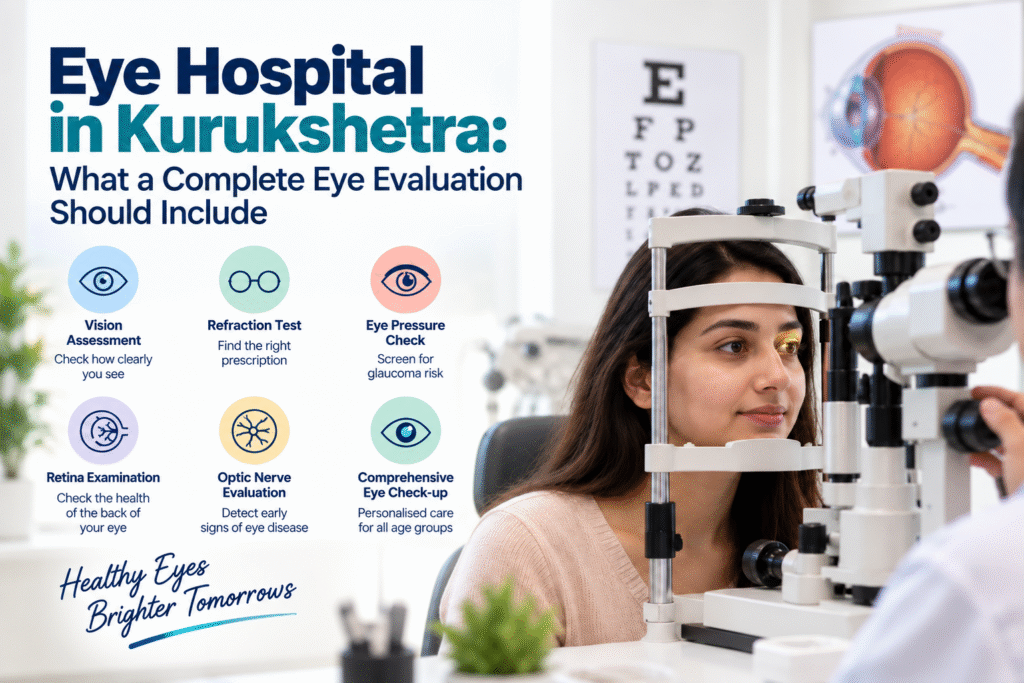
Good vision is not only about being able to read a chart or seeing clearly with your glasses. Many eye conditions can develop gradually without causing noticeable symptoms in the early stages. A proper eye evaluation can identify vision problems, assess the health of the eyes and help determine whether a person needs routine monitoring, medical treatment, specialist care or surgery.
For people searching for the eye hospital in Kurukshetra, one of the most important questions is not simply where to get an eye test. It is whether the eye care centre can evaluate different aspects of eye health and guide patients to the appropriate treatment when a problem is detected.
At Saini Eye Care Centre, Kurukshetra, comprehensive eye care includes services for cataract, retina conditions, glaucoma, LASIK and refractive problems, pediatric eye conditions, cornea and dry eye concerns. The centre also provides access to ophthalmic consultation and surgical care under one roof.
A complete eye evaluation can be particularly important for older adults, people with diabetes or high blood pressure, children with suspected vision problems, people experiencing changes in vision and anyone with a family history of certain eye diseases.
Why a Complete Eye Evaluation Matters
Many people visit an eye doctor only when their vision becomes blurry or their glasses no longer seem effective. While these are valid reasons for an examination, eye health is broader than visual sharpness.
A comprehensive examination may assess:
- How clearly you see at different distances
- Whether you have a refractive error
- Eye pressure
- The health of the optic nerve
- The retina and other structures inside the eye
- Peripheral or side vision
- Eye movement and coordination
- Signs associated with cataract, glaucoma or retinal disease
- Changes that may require further diagnostic testing
Some eye diseases can remain unnoticed until they have already affected vision. A dilated eye examination allows an eye-care professional to examine structures inside the eye and look for signs of conditions such as glaucoma, diabetic retinopathy and age-related macular degeneration.
This is why an eye examination should not always be viewed simply as a test for glasses.
What Happens During an Eye Examination?
The exact tests performed depend on the patient’s age, symptoms, medical history and risk factors. A doctor may begin with questions about vision, previous eye problems, medications, family history and general health.
1. Visual Acuity Testing
Visual acuity testing measures how clearly each eye can see.
You may be asked to read letters or symbols from a standard distance. The test is commonly performed for both distance and near vision.
Reduced visual acuity can be associated with refractive errors such as:
- Myopia
- Hyperopia
- Astigmatism
- Presbyopia
A prescription for glasses or contact lenses may be recommended when appropriate.
However, good visual acuity does not necessarily mean that every part of the eye is healthy. Other examinations may still be necessary.
2. Refraction Assessment
A refraction examination helps determine whether corrective lenses could improve vision.
For people who are frequently changing their glasses prescription, experiencing blurred vision or struggling to see clearly at certain distances, a proper refraction assessment can help identify the underlying refractive requirement.
Patients considering LASIK or another refractive procedure may require additional examinations to determine whether they are suitable candidates.
3. Eye Pressure Measurement
Eye pressure, also known as intraocular pressure, may be measured as part of an eye evaluation.
This is particularly relevant when glaucoma is suspected or when a person has risk factors for the disease.
However, eye pressure alone does not diagnose glaucoma. A complete glaucoma assessment may involve examination of the optic nerve, visual field testing and other investigations depending on the individual case.
Saini Eye Care Centre provides glaucoma evaluation and management, including diagnostic services such as tonometry, visual field testing, gonioscopy and OCT where clinically appropriate.
Learn more about glaucoma care:
Why Glaucoma Screening Is Important
Glaucoma can damage the optic nerve and may progress without obvious symptoms in its early stages.
That makes regular assessment important, particularly for people who have relevant risk factors or have been advised to undergo glaucoma monitoring.
A comprehensive evaluation may include:
- Eye pressure measurement
- Optic nerve assessment
- Visual field testing
- Examination of the drainage angle when indicated
- OCT imaging when clinically appropriate
- Follow-up examinations
The purpose is not simply to record an eye-pressure number. The doctor considers multiple findings together to determine whether there are signs of glaucoma or whether continued monitoring is required.
Dilated Examination of the Retina
A dilated eye examination allows the doctor to obtain a better view of structures at the back of the eye.
This can help in assessing the retina and optic nerve and may help identify signs of several eye diseases.
Retinal evaluation is particularly relevant for:
- People with diabetes
- People with unexplained changes in vision
- Patients experiencing flashes or new floaters
- People with retinal disease
- Individuals with certain family or medical risk factors
- Older adults who require routine eye-health monitoring
People with diabetes deserve particular attention because diabetic retinopathy may have few or no symptoms in its early stages.
Regular eye examinations can help identify retinal changes before significant vision loss develops.
Diabetes and Eye Health: When Should You Get Checked?
Diabetes can affect the small blood vessels supplying the retina and may lead to diabetic retinopathy.
A person with diabetes should not wait until vision becomes blurry before discussing eye examinations with an eye-care professional.
The frequency of examinations depends on the individual’s medical and eye-health situation. People with diabetes are generally advised to have regular comprehensive eye examinations, with the exact schedule determined by their doctor.
If you have diabetes and notice:
- Sudden changes in vision
- New floaters
- Flashes
- Blurred vision
- Distorted vision
- Dark or empty areas in your field of vision
you should seek prompt medical assessment.
Saini Eye Care Centre provides retina care for conditions including diabetic retinopathy, retinal detachment and macular conditions.
Explore the retina care service:
Cataract Assessment Is More Than Checking Your Glasses
Cataract is another common reason people seek an eye consultation.
A cataract occurs when the natural lens of the eye becomes cloudy. Patients may gradually notice:
- Blurred or cloudy vision
- Glare around lights
- Difficulty seeing at night
- Faded colours
- Frequent changes in spectacle prescription
- Difficulty reading
- Reduced confidence while driving
Cataract progression can be gradual, so some people adapt to reduced vision without immediately realising how much their eyesight has changed.
An ophthalmologist can examine the eye and determine whether the symptoms are related to cataract or another eye condition.
When cataract begins to interfere with everyday activities, surgery may be discussed.
Saini Eye Care Centre provides cataract surgery and offers evaluation of IOL options as part of the treatment-planning process.
Read more about cataract surgery:
When Is Cataract Surgery Considered?
There is no single visual-acuity number that automatically means a person needs cataract surgery.
The decision depends on factors such as:
- How much the cataract affects vision
- Difficulty performing everyday activities
- Impact on work or driving
- Glare and night-vision problems
- The condition of the eye
- The patient’s expectations
- The doctor’s clinical assessment
The most appropriate treatment should be determined after an individual examination.
LASIK Evaluation: Who May Need a Refractive Assessment?
People who depend on glasses or contact lenses sometimes explore LASIK or other refractive procedures.
LASIK is designed to correct certain refractive errors, including myopia, hyperopia and astigmatism.
However, not everyone who wears glasses is automatically suitable for LASIK.
Before considering surgery, an eye specialist may assess:
- Current refractive error
- Corneal shape
- Corneal thickness
- Stability of the prescription
- General eye health
- Tear-film or dry-eye concerns
- Other factors relevant to surgical suitability
The goal of the pre-operative evaluation is to determine whether a refractive procedure is appropriate and which option, if any, is suitable.
Saini Eye Care Centre provides LASIK and refractive surgery services in Kurukshetra.
Read more:
Children Need a Different Approach to Eye Care
Children cannot always explain that they are struggling to see.
A child may simply avoid reading, sit too close to a screen, perform poorly in school or appear uninterested in visually demanding activities. In some cases, there may be an underlying refractive or binocular vision problem.
Pediatric eye care can include assessment and management of conditions such as:
- Refractive errors
- Squint
- Lazy eye
- Pediatric cataract
- Pediatric glaucoma
- Certain retinal conditions
- Other childhood eye disorders
Early detection can be particularly important because vision development occurs during childhood.
Parents should consider an eye evaluation if a child frequently:
- Squints to see
- Holds books very close
- Sits unusually close to the television
- Complains of headaches after visual activities
- Has one eye that turns in or out
- Closes one eye while looking at something
- Struggles to see the board
- Has difficulty with reading or visually demanding tasks
Saini Eye Care Centre provides pediatric ophthalmology services, including vision screening, refractive-error management, squint care and lazy-eye therapy.
Learn more:
Dry Eye and Corneal Problems Should Not Be Ignored
Not every eye complaint is related to cataract, glaucoma or refractive error.
Dryness, burning, irritation, watering, foreign-body sensation and fluctuating vision can occur with dry-eye conditions and other ocular-surface problems.
Corneal conditions can also affect the clarity of vision.
Depending on the symptoms, the doctor may assess the ocular surface, cornea, tear film and other structures before recommending appropriate treatment.
Saini Eye Care Centre lists a Cornea & Dry Eye Clinic among its eye-care services.
Patients experiencing persistent eye irritation or fluctuating vision should avoid assuming that the problem is simply due to screen use or tiredness. A proper evaluation can help determine the cause.
When Should You Visit an Eye Hospital in Kurukshetra?
You do not always need to wait for severe symptoms before arranging an eye examination.
Consider an eye consultation if you experience:
- Persistent blurred vision
- Difficulty seeing at night
- Frequent changes in glasses prescription
- Eye pain
- Redness that does not settle
- Double vision
- New floaters
- Flashes of light
- Distorted vision
- Loss of peripheral vision
- Difficulty reading
- Increasing glare
- Sudden changes in eyesight
Some symptoms require more urgent evaluation.
A sudden loss or significant change in vision, sudden flashes with a large increase in floaters, a curtain-like shadow over the field of vision, severe eye pain or other sudden serious symptoms should not be ignored.
Who Should Consider Regular Eye Examinations?
The right frequency depends on age, health, symptoms, family history and previous eye findings.
Regular examinations can be especially important for people who:
Have diabetes
Diabetes can increase the risk of diabetic retinopathy and other eye problems. Regular retinal assessment is important even when vision appears normal.
Have high blood pressure
High blood pressure can be associated with changes affecting the eyes, and your doctor can advise you about the appropriate eye examination schedule.
Have a family history of glaucoma
Family history can increase glaucoma risk, making appropriate monitoring important.
Are older adults
The risk of several eye conditions increases with age. Regular eye examinations can help detect changes earlier.
Have already been diagnosed with an eye condition
People with glaucoma, retinal disease, cataract or other eye conditions may require scheduled follow-ups to monitor progression and treatment response.
What Makes a Comprehensive Eye Hospital Useful for Families?
For a family, eye-care needs can vary significantly.
One family member may need cataract evaluation. Another may need glaucoma monitoring. A child may need assessment for squint or refractive error, while a younger adult may be considering LASIK.
Having access to multiple areas of ophthalmic care can make it easier to receive the appropriate evaluation and specialist guidance without treating every eye complaint as the same problem.
Saini Eye Care Centre lists cataract surgery, retina care, glaucoma management, LASIK and refractive surgery, pediatric ophthalmology, and cornea and dry-eye care among its services.
The centre is located at:
Saini Eye Care Centre
#218, Sector 7, Pipli Road, Sector 7, Kurukshetra, Haryana 136118
For appointments and enquiries, the official website lists 01744 227 050 as the reception number. The website also provides an online appointment/contact option.
Contact the centre:
Why Saini Eye Care Centre Can Be Considered for Comprehensive Eye Care in Kurukshetra
When people search for the eye hospital in Kurukshetra, their requirements can be very different.
Saini Eye Care Centre focuses on comprehensive ophthalmic care, with services covering common and specialised eye conditions.
The official website identifies:
- Experienced ophthalmologists and trained staff
- Advanced diagnostic and surgical equipment
- Comprehensive eye care under one roof
- Patient-focused treatment
- Cataract and refractive surgery expertise associated with Dr Rajesh Saini
- Retina, glaucoma and pediatric eye-care services
Dr Rajesh Saini is listed by the centre as an M.S. Ophthalmologist specialising in cataract and refractive surgery.
The most appropriate eye hospital or specialist for an individual patient should always depend on the diagnosis, treatment requirement, doctor’s assessment and patient’s circumstances.
How to Prepare for Your Eye Appointment
A little preparation can make your consultation more useful.
Before your appointment, make a note of:
- Any recent changes in your vision.
- When the symptoms started.
- Whether one or both eyes are affected.
- Any previous eye surgeries.
- Your current glasses or contact-lens prescription.
- Medicines you are taking.
- Any history of diabetes or high blood pressure.
- Eye diseases in close family members.
- Previous reports or scans, if available.
- Questions you want to ask the ophthalmologist.
If you have previous eye reports, carrying them to the consultation can help the doctor understand changes over time.
If pupil dilation is expected, ask whether you should arrange someone to accompany you or help with transport. Dilation can temporarily cause light sensitivity and blurred vision.
Questions to Ask Your Eye Doctor
A useful eye consultation is a two-way conversation.
Depending on your condition, you may want to ask:
- What is causing my current vision problem?
- Do I need glasses or a change in prescription?
- Is there any sign of cataract?
- Is my eye pressure within an appropriate range for me?
- Do I need a retinal examination?
- Should I be monitored for glaucoma?
- Are my symptoms related to dry eye?
- If I have diabetes, how often should my eyes be checked?
- Is surgery necessary now or can the condition be monitored?
- What symptoms should make me return sooner?
Understanding the reason behind a recommended test or treatment can help you make informed decisions about your eye health.
Frequently Asked Questions About the Eye Hospital in Kurukshetra
1. What should I look for when choosing the eye hospital in Kurukshetra?
Look for comprehensive ophthalmic services, qualified eye specialists, appropriate diagnostic facilities, clear treatment explanations, follow-up care and services relevant to your specific condition. The right choice ultimately depends on your individual medical needs.
2. How often should I have a complete eye examination?
There is no single schedule that applies to everyone. Age, medical history, family history, symptoms and existing eye conditions all influence how frequently you should be examined. Your ophthalmologist can recommend an appropriate schedule.
3. Can an eye examination detect glaucoma before I notice symptoms?
Yes. Glaucoma can develop without obvious symptoms in its early stages. A comprehensive eye evaluation can assess factors such as the optic nerve, eye pressure and visual field to determine whether further glaucoma evaluation or monitoring is needed.
4. Should people with diabetes have regular eye examinations?
Yes. Diabetes increases the risk of diabetic retinopathy and other eye conditions. Regular comprehensive eye examinations are important because diabetic retinal disease may not cause noticeable symptoms in its early stages.
5. When should I see a cataract specialist?
You should consider an eye consultation if you have persistent blurry vision, glare, difficulty seeing at night, faded colours, frequent prescription changes or difficulty performing normal activities. An ophthalmologist can determine whether cataract is responsible and whether treatment is required.
6. Is LASIK suitable for everyone who wears glasses?
No. LASIK suitability depends on factors including the type and stability of the refractive error, corneal characteristics and overall eye health. A detailed pre-operative evaluation is required before deciding whether LASIK is appropriate.
7. What eye problems are commonly treated in children?
Children may need care for refractive errors, squint, lazy eye, pediatric cataract, pediatric glaucoma and other eye conditions. Early assessment can be important because untreated vision problems may affect visual development.
8. What symptoms require an urgent eye examination?
Sudden vision loss or a significant sudden change in vision, severe eye pain, new flashes with a sudden increase in floaters, or a curtain-like shadow across the field of vision can require urgent medical assessment. Do not delay seeking professional care when serious symptoms appear.
9. Does a normal glasses prescription mean my eyes are completely healthy?
Not necessarily. A glasses prescription primarily addresses refractive vision. Some eye diseases can develop without obvious changes in how clearly you see. A comprehensive eye examination may be needed to assess the overall health of the eyes.
10. How can I book an appointment at Saini Eye Care Centre in Kurukshetra?
You can contact Saini Eye Care Centre through its official contact page or by calling 01744 227 050. The centre is located at #218, Sector 7, Pipli Road, Sector 7, Kurukshetra, Haryana 136118.
Takeaway: Good Eye Care Starts With the Right Evaluation
Searching for the eye hospital in Kurukshetra should not be limited to comparing names or locations. A more useful approach is to understand what type of eye care you actually need.
A comprehensive examination can help identify refractive problems, cataract, glaucoma, retinal disease and other conditions that may require monitoring or treatment. For children, early assessment can help identify problems that may interfere with visual development. For people with diabetes or other risk factors, regular eye examinations can be an important part of protecting long-term vision.
Saini Eye Care Centre provides multiple areas of ophthalmic care in Kurukshetra, including cataract surgery, retina care, glaucoma management, LASIK and refractive surgery, pediatric ophthalmology, and cornea and dry-eye care.
If you are experiencing a change in your vision or have been advised to undergo an eye examination, arranging an evaluation with a qualified eye-care professional is a sensible next step.
Saini Eye Care Centre
#218, Sector 7, Pipli Road, Sector 7, Kurukshetra, Haryana 136118
Phone: 01744 227 050
Website: https://sainieyecarecentre.com/